A Dominican Adventure
There’s no other way to explain the trip: it was an adventure. I had no idea how much planning, coordinating, and anxiety would go into what was meant to be a family vacation and research grant. I was excited to go. I’d always wanted to visit Samaná, a region steeped in history and culture that felt both familiar and foreign. Born and raised in Harlem, a predominantly Black historic neighborhood in New York City bordering Washington Heights, a Dominican neighborhood, I’ve long been curious about the ways these worlds intersect, not just in NYC but in the Dominican Republic itself. Samaná held a unique place in my imagination, having been intended as a Black nation in the early 1800s when it was all Haiti, following the Haitian Revolution. It was a trip of a lifetime, and I wanted my family to experience it with me. After all, I hadn’t been to the DR in 25 years! It felt like discovering it all over again.
Our adventure began early, on Sunday, June 1. We woke up at 4 a.m. and began what would become a restless day. Most of us, including my mom traveling from New York City, did not sleep well. When we arrived at the Louisville airport, I was instantly hit with a sick feeling in my stomach; the American Airlines bag check-in line snaked endlessly, and anxiety started to mount as I worried we might miss our flight. After finally tagging our bags, another wave of stress hit: I realized I hadn’t updated my parking garage information for our broken-down car that needed $4,000 in repairs. My attempt to fix this while in the TSA line ended with the parking operator hanging up on me, leaving me to rely on prayer for a smooth exit upon return. We boarded the plane in the nick of time.

The flight to Miami was smooth, and a quick coffee and snack break kept us going. However, our connecting flight to Santo Domingo was delayed by 90 minutes, and was turbulent most of the way, which meant no snacks. We were getting exhausted. By the time we landed at 2:30 p.m., we were met with sweltering heat, no cell service, and long waits at the rental car counter, punctuated by unexpected charges for insurance. My mom’s cousin, who was supposed to pick her up and exchange money for us, had both forgotten and arrived late, leaving her to eat alone at a fast-food joint outside the airport. And we did not end up exchanging money with him, something I could have done at the countless money exchange booths we had passed on our way to the exit.

Navigating Santo Domingo was its own experience. With no Wi-Fi for GPS, we relied on my mom’s cousin to guide us to our Airbnb, which, despite its modern façade, was in a neighborhood that felt unsafe. Dirt roads, motorbikes, and an unsettling lack of security heightened our discomfort. My mom's cousin admitting that it was an unsafe area and that anyone at any moment could come and rob us did not help. As we waited for the absent security guard to open the parking lot gate, as per the Airbnb host, we witnessed a woman scaling the gate to let herself into the complex, and that cemented my decision: we couldn’t stay there. Fortunately, an old friend from my NYC Teaching Fellows days lives and teaches in Santo Domingo. We had plans to stay with her during our last night in Santo Domingo, but I asked if she could host us that night. She was more than welcoming, but her 5am start of the workday the next day complicated things a bit, so she helped us check into a hotel instead. Unfortunately, while the hotel was luxurious on the surface (with a fancy restaurant offering breakfast and dinner buffets), the long check-in, musty room, and standoffish staff made for a restless night.
By the next day, things improved. We made the three-hour drive northeast through the serene and lush country and arrived in Samaná. We settled into a picturesque Airbnb in the center of the town right by the bay. The walkable area and scenic boardwalk felt like a breath of fresh air. The trip’s highlight came the next day, on June 3, with an excursion to Cayo Levantado. Boarding the wobbly boat was nerve-wracking, but the pristine beach and family-style lunch calmed my anxiety.


On the walk from the boat to the beach, we passed small gift shops and met Él Gemelo, the quick and slick shop owner. He pulled the classic move: placing a bracelet on my wrist as a "gift," then swiftly tossing more jewelry my way. I ended up buying my mom an overpriced necklace and my son a shark necklace that kept coming undone. After sealing the deal, Él Gemelo casually offered my husband some weed (which he rejected).
Once we reached the beach, we met Sobeida, a charismatic and hustling tour guide. She was already guiding an Argentinian couple but somehow found the time to charge us 600 pesos for the public beach lounge chairs. My husband noticed that she didn’t seem to charge others after us. (A couple of days later, I learned that it’s actually customary to charge for lounge chairs unless you’re with an all-inclusive excursion package. Initially, though, it reinforced the stereotype of Dominicans being natural hustlers or tricksters ("tigueraje"), something I had grown up wanting to disprove.)
As we chatted with Sobeida, Karina approached us. She took my hand, started massaging it, and introduced herself as a massage therapist. Instantly, I was sold. I was ready for some relaxation! When I mentioned I hadn't brought enough money to the beach, she stopped the free hand massage mid-stroke. Sobeida quickly intervened, reassuring Karina (and me) that we could pay once we got back to the boardwalk. Karina agreed, and I asked my mom if she wanted a massage as well. My mom initially suggested waiting until we were back at the Airbnb, but she was convinced to go for it on the beach.

As we walked over, Karina leaned in, grabbed my hand, and told me to keep it quiet, but she could exchange numbers with me and come to the Airbnb to do my mom’s second massage. She just didn’t want the other women to find out and bother her about it. I agreed.
The massages at the beach were great! I exchanged numbers with Sobeida in case we wanted a tour guide, though she was persistent, mentioning to my husband that I had hired her and we would all see each other the next day (which was not true). I also exchanged numbers with Karina so I could meet her by the Catholic church near the Airbnb that afternoon to pay her. We could then plan to set up a time for my mom’s at-home massage.
Lunch at Cayo Levantado was okay. The place itself looked like an untouched paradise with the cutest little shops and food huts. I was excited for the fish, imagining it fresh and juicy, but it wasn’t. The rest of the food was just ok. By this point, I’d spent days just picking at meals or eating portions too small to keep me full (even prior to arriving in the DR), and it was starting to wear on me, especially being newly gluten-free.
The ride back to the boardwalk was nerve-wracking. It was such a small boat carrying my entire family. This trip was entirely my plan, and to make matters worse, there wasn’t a single life vest. I was a ball of anxiety and felt so much relief when we made it back safely. We got off the boat, grabbed some ice cream, and walked back to the Airbnb.

Later that afternoon, my husband and I met up with Karina to pay her what we owed. She casually told us not to worry about hiring Sobeida since we had a car rental and could visit places on our own. It made sense, especially since my husband can’t stand salespeople and immediately got a hustler vibe from Sobeida anyway. (A couple of days later, I also didn't like the idea about having a massage therapist, a practical stranger, come to the Airbnb. Even though we’d set it up, we canceled my mom's in-house massage with Karina the night before. Thankfully, Karina was understanding about it.)
That night, after a long day, my husband and I left the kids with my mom and went out for a couple of drinks at our new favorite local restaurant. When we got back, we spent some time upstairs on the terrace, chatting with my mom and unwinding. It was the perfect end to the day.

That day in Cayo Levantado gave us a colorful introduction to Dominican hustle culture and reminded me of the stereotypes surrounding Dominican ingenuity and survival, but they also left me questioning how much of these stereotypes I had internalized growing up in NYC. As the week progressed, I also found myself reflecting on identity and belonging. Visiting the African Methodist Episcopal (AME) Church, one of the oldest and few remnants of African-American culture on the island, was a profound experience. The AME Church was founded in 1816 by Richard Allen and others in Philadelphia. It was the first independent Black denomination in the United States. Richard Allen was born into slavery, but bought his freedom and the church was created as a response to racism and segregation in white Methodist congregations, providing Black people with a space for worship, leadership, and community. The AME church in Samaná was built in 1824, but due to some conflicts, moved to a second site around 1837. The original site is now Saint Peter's Church, an evangelical church.
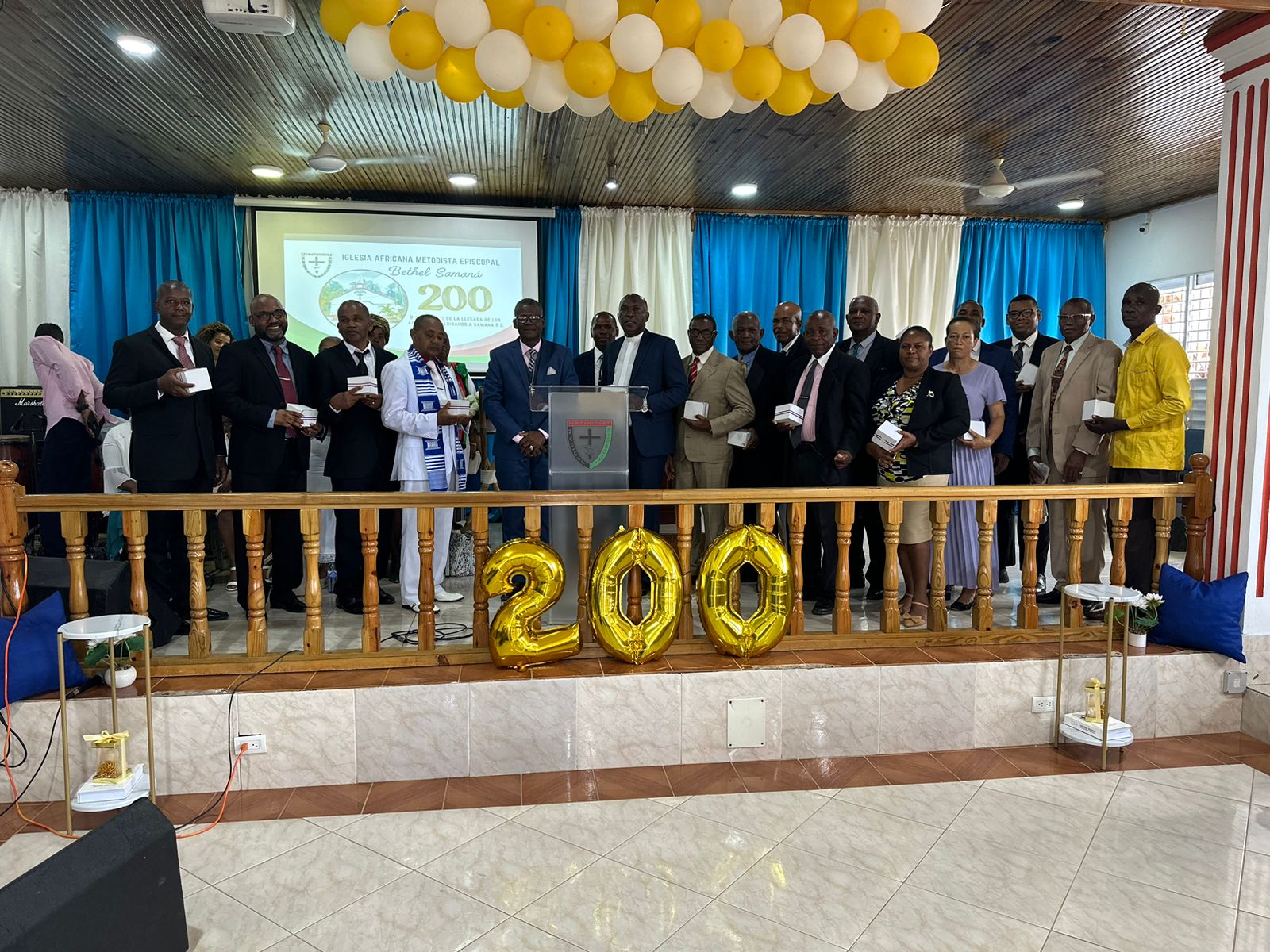
(Image from The Christian Recorder's online article on the AME church's 200 year anniversary celebration in the fall of 2024.)
Learning from the AME pastor, Reverend Justino Rodríguez Jones, a descendant of the first African-American migrants from 1824, brought my research to life. From my readings prior to arriving in Samaná, I knew that there was not much left of African-American culture. My conversation with the pastor confirmed this for me. Reverend Justino mentioned the church's tie to the United States because is purely due to it being a conciliar church, meaning that it is connected through a centralized administrative structure coming from the U.S. Still, he gave the sense that it wasn't a strong or overpowering connection in its impact on the culture of the church and community. Other than its origins and this conciliar tie, there wasn't much that made this AME church uniquely African-American or even Black West Indian or Haitian (these are the three communities that collaborated to create a Black nation back in the early 1800's). As a young adult, I had heard of people in Samaná who still spoke English, but I did not find this during my visit. As the pastor's last name shows, however, American last names still commonly exist in Samaná.
So much was erased the history and culture, especially under the mid-20th century anti-Black dictatorship of Rafael Trujillo; there were racist legislation and policies, state-sanctioned violence, cultural suppression, and even racial cleansing. Some of these things still plague the country, such as anti-Haitian legislation and policies. Of course, assimilation is a real thing, especially for survival and safety, and even just belonging. Samaná is unmistakably Dominican, seamlessly woven into the fabric of the nation rather than feeling like an isolated community of Black descendants. The pastor's raised eyebrows and light sigh as he explained that many have come through the region wanting to study the Black history of Samaná gave me the sense that there is pride, but also overwhelm and I wonder if perhaps a bit of not wanting to be considered so separate from the national identity.
There were high hopes for a Black nation in the Americas. It was a bold attempt, a collaboration between Haitians, African Americans, and Black West Indian migrants, which I did not realize until my research, my biggest source being Christina Cecilia Davidson, a historian of the Caribbean and African diaspora. What I observed in Samaná felt like mere remnants, a "West Indies Real Estate" sign on a lush, rural road, the rich melanin and coiled textures of the people's hair, and the AME logo on a podium boldly displaying Pan-African colors for each word in the church's name, black for African, red for Methodist, and green for Episcopal, and stained glass art of a Black Jesus surrounded by sheep at the entrance of Santa Bárbara Catholic Church, built in the late 18th century, in the center of the town.

We visited the original site of the AME church, now Saint Peter's, a Dominican Evangelical church. Across the street stood Santa Barbara Catholic Church, a relic of colonialism's imposed religion. The contrast between the two symbolized faith and resistance. While the Dominican Republic sought to establish itself as a Catholic nation, some recognized the importance of celebrating Black culture and creating a church community that served as a home for Black people striving to build a Black community or nation, not just adhering to the religion imposed by colonizers. The AME church, created by and for Black people, offered something the Catholic Church or any other denomination could not. It’s fitting that the AME church became a grounding space—a home and a centerpiece—in the effort to build a Black nation on the island. Interestingly, we saw Mormon missionaries walking around, which reminded me of the LDS church's anti-Black history, including its past ban on Black people holding the priesthood, their higher levels of leadership. Yet there they were, in a historic Black community with deep AME roots, trying to convert souls. Having been Mormon throughout my teen years, seeing them in this space brought up unexpected feelings.

African Methodist Episcopalian (AME) Church in Samaná

Santa Bárbara Catholic Church in Samaná

The original AME church, now Saint Peter's Church, in Samaná

Saint Peter's Church

Saint Peter's Church and Santa Bárbara Catholic Church
On the Friday before our Sunday flight back to the states, we visited Playa Ballenas in Las Terrenas, on the north side of Samaná. It was absolutely gorgeous, the water was blue and crystal clear, framed by tall palm trees. On that weekday morning before peak season, we practically had the beach to ourselves. The weather was perfect: a bit windy, but sunny and not too hot. Sitting in the sand and water, surrounded by beautiful seashells, was a truly memorable experience. It was a rare moment of relaxation during an otherwise busy trip.


Perhaps that’s why, as the trip wound down, my mind turned to Louisville and the life I’ve built there. The person who once thrived on NYC’s grit now finds solace in the calm of Goshen, with its quirky charm. Returning to the Dominican Republic after 25 years was both grounding and disorienting, a reminder of where I come from and how far I’ve traveled, in every sense of the word.


Comments
Post a Comment